Showing posts with label reference. Show all posts

Thursday, November 22, 2018

Lost Scenes

Star Trek: Lost Scenes by David Tilotta & Curt McAloney
Release date: August 21st 2018
Read November 9th 2018


Purchase:
Hardcover: Amazon.com | Amazon.ca | Amazon.co.uk

Publisher's description:
Think you know everything about the Original Series? Think again. Star Trek: The Lost Scenes is packed with hundreds of never-before-seen color photos of the world's ultimate sci-fi series. Professionally restored images are used to chronicle the making of the series, reassemble deleted scenes, and showcase bloopers from the first pilot through the last episode. Whether you're a new Star Trek fan or a seasoned veteran, this book is a must-have.

My thoughts:

Click here to watch my video review of Star Trek: Lost Scenes, or click play on the embedded video below!


Final thoughts:

An incredibly well-put together book featuring tidbits gathered from all three seasons of The Original Series. I can honestly say, as a life-long fan of Trek who thought he knew everything there was to know about it, I was surprised by a lot of what is in this book. A huge bonus was learning a lot about the craft and art of making a science fiction television series in the 1960s! Tilotta and McAloney have put together a masterpiece that is sure to impress both hardcore fans and new fans alike!

More about Lost Scenes:


Next time on Trek Lit Reviews:

Star Trek #88: Across the Universe by Pamela Sargent & George Zebrowski.


Saturday, June 30, 2018

The Autobiography of Jean-Luc Picard

The Autobiography of Jean-Luc Picard
The Story of One of Starfleet's Most Inspirational Captains
Edited by David A. Goodman
Release date: October 17th 2017
Read October 31st 2017


Previous: The Autobiography of James T. Kirk
Next book: The Autobiography of Mr. Spock


Hardcover: Amazon.com | Amazon.ca | Amazon.co.uk
Kindle: Amazon.com | Amazon.ca | Amazon.co.uk

Publisher's description:
The Autobiography of Jean-Luc Picard tells the story of one of the most celebrated names in Starfleet history. His extraordinary life and career makes for dramatic reading: court martials, unrequited love, his capture and torture at the hand of the Cardassians, his assimilation with the Borg and countless other encounters as captain of the celebrated Starship Enterprise.

My thoughts:

Click here to watch my video review of The Autobiography of Jean-Luc Picard, or click play on the embedded video below!


Final thoughts:

A fun and entertaining overview of the life of Jean-Luc Picard, adding a lot of context and meaning to the events of The Next Generation. Fans will find themselves re-watching episodes with more subtext thanks to this book. David A. Goodman clearly has a huge love and respect for the Star Trek universe, and he definitely knows his stuff!

More about The Autobiography of Jean-Luc Picard:


Also by David A. Goodman:

Next time on Trek Lit Reviews:

Next review: the Deep Space Nine e-book novella, I, The Constable, by Paula M. Block & Terry J. Erdmann.


Thursday, March 8, 2018

Hidden Universe Travel Guide to The Klingon Empire

Hidden Universe Travel Guides
Star Trek: The Klingon Empire by Dayton Ward
Release date: July 11th 2017
Read August 3rd 2017


Previous book (Hidden Universe Travel Guides): Vulcan


Purchase:
Trade Paperback: Amazon.com | Amazon.ca | Amazon.co.uk

Publisher's description:
nuqneH! Bored of standard vacations to places like Risa or Wrigley’s Pleasure Planet? Want to discover a unique and ancient culture not bound by standard niceties and social mores? Then Qo’noS and the vast Klingon Empire are for you! This one-of-a-kind travel guide will give you all the information you need to plan, enjoy, and survive your trip to the very heart of Klingon territory, from an overview of Klingon history to tips on what to wear (fur and leather are very popular) to a glossary of important phrases like “mamI' DaneH'a'? nItebHa' mamI' DaneH'a'?” (Would you like to dance with me?). Every major location in the Klingon Empire is covered in-depth, with tips on where to eat (you’ve not lived until you’ve eaten Klingon skull stew), how best to get to and from your chosen destination, and what to do if you find yourself challenged to a bat’leth battle to the death. Locations include the homeworld Qo’noS and its famous locales such as the First City, the Caves of No’mat, the Hamar Mountains, and the city of Krennla, plus neighboring moons Corvix and Praxis, and many, many more must-see areas. The book also features exclusive maps and illustrations that bring to life the Klingon Empire and form the perfect reference guide for any visitor. So what are you waiting for? Qapla’!

My thoughts:

Click here to watch my video review of The Klingon Empire travel guide, or click play on the embedded video below!


Final thoughts:

This book makes The Klingon Empire come alive! Beautiful illustrations and great prose written in Dayton Ward's trademark wit make this a perfect addition to any Trek fan's bookshelf. There are tons of great easter eggs and references for the fan who knows his or her Star Trek backwards and forwards, but this is a great book for the more casual fan, too.

More about The Klingon Empire travel guide:


Also by Dayton Ward:

Next time on Trek Lit Reviews:

My next review is for the first original Deep Space Nine novel, The Siege, from way back in 1993!


Wednesday, July 27, 2016

The Star Trek Book

The Star Trek Book
Strange New Worlds Boldly Explained
by Paul Ruditis, Sandford Galden-Stone, and Simon Hugo
Release date: June 7th 2016
Read July 9th 2016

*Note: The text of this review was first published on Trekcore.com


Publisher's description:
Who was the captain of the first Starship Enterprise? In which galactic quadrant is planet Earth located? And just what is the trouble with tribbles? Covering several centuries of intergalactic history, The Star Trek Book answers these questions and many more. 
This comprehensive guide contains in-depth explanations of technological advances and key events in the Star Trek universe. It also includes detailed profiles of memorable characters, such as Starfleet personnel as well as their allies and enemies. 
Packed with informative graphics, memorable quotes, and stills and props from the television series and movies, this book boldly explores and explains everything you need to know about 50 years of thrilling adventures across the final frontier. 


Unless you have been living under a rock, you know that 2016 is Star Trek's 50th anniversary. With that milestone occasion, we have seen an increase in the number of tie-in media and products being released. One such tie-in, The Star Trek Book, promises to be a comprehensive, authoritative guide to the Star Trek universe. Does this title meet those expectations? Can it possibly rise to the occasion of being a "comprehensive" overview of this franchise that spans 50 years and boasts a fanbase that is singularly critical of all incarnations and knowledgeable about all aspects of said franchise? Read on to find out!


My thoughts:

First off, this book is laid out very well. It is divided into a number of sections that highlight various aspects of Trek. A general overview starts out the book, introducing the reader to the broad strokes of the setting of Star Trek. Next comes "Starfleet," in which each of the main characters from the various series is profiled. Most of the characters get a two page spread, except for the TOS characters who get four: two for the prime universe, and two for their "Kelvin Timeline" counterparts.

Each character gets a section highlighting their role in Star Trek.

"Federation Allies and Enemies" is next, showcasing various species, groups, and individuals from throughout Star Trek history. These are the main ones, like the Klingons, the Cardassians, Khan, and the Maquis. After that comes "Science and Technology," in which Star Trek staples like warp drive, the transporter, and holodecks are explored. Finally, "New Life and New Civilizations" concludes the book, with a look at a few of the "leftovers"; aliens that are somewhat important to Star Trek as a whole, but maybe didn't quite make the bar for the previous section. V'Ger, The Guardian of Forever, and the Pah-wraiths are a few examples of topics in this category.

"Federation Allies and Enemies" contains information about the many races we see in Star Trek, including the Cardassians and the infamous Gul Dukat.

This surprisingly effective layout makes it really easy to find the particular section you're looking for, especially with the clear table of contents as well as an extremely thorough index. Can't quite remember what species Kes was? It's easy to look it up in seconds.

If you are a casual Star Trek fan, or even a newbie, this book is a really great introduction to the franchise. There is a lot of information here, but it is organized quite effectively. The broad overviews serve as a terrific way for a new fan to quickly get up to speed, while at the same time presenting information in a new and interesting way so that even the most hardcore fan can get enjoyment from the book. The graphics are often fun, illustrating concepts like the Vulcan mindmeld or Kirk's doppelgangers throughout the years.


Given the limited space in the book, I often found myself impressed with just how much information the authors managed to include. While hardly near the scope of the Star Trek Encyclopedia (of which we will soon have an updated version), the amount of research and information crammed into this book is impressive. You won't find an episode-by-episode guide, but you will also be hard-pressed to think of a crucial piece of the Star Trek tapestry that the authors of this books missed!

Final thoughts:

Even for a hardcore fan like myself, who has basically every fact from every series and film in the Star Trek universe memorized, The Star Trek Book nonetheless will have a place on my bookshelf. Beautifully laid out and featuring gorgeous full-color photos and illustrations, this book is perfect for the newbie to Star Trek, as well as the more seasoned fans. A few years ago, a friend of  mine who had seen the 2009 Star Trek film wanted to get into the rest of the Trek universe. I gave her a copy of Star Trek 101 by Terry J. Erdmann and Paula M. Block. While I still really like that book, I think that if it were around at the time, I would have included The Star Trek Book as well. The overview of the Star Trek universe that it provides is simply unparalleled. A great gift for trekkies, trekkers, and trek-curious alike!


Next time on Trek Lit Reviews:

Playing a bit of catch up here! Next review is for Dayton Ward's latest, The Original Series: Elusive Salvation, a sequel to his excellent novel From History's Shadow. Coming soon!

Sunday, October 4, 2015

The Autobiography of James T. Kirk

The Autobiography of James T. Kirk
The Story of Starfleet's Greatest Captain
by James T. Kirk (edited by David A. Goodman)
Release date: September 8th 2015
Read September 23rd 2015


Next book: The Autobiography of Jean-Luc Picard


Hardcover: Amazon.com | Amazon.ca | Amazon.co.uk
Kindle: Amazon.com | Amazon.ca

From the back cover:
The Autobiography of James T. Kirk chronicles the greatest Starfleet captain's life (2233–2371), in his own words. From his birth on the U.S.S. Kelvin, his youth spent on Tarsus IV, his time in the Starfleet Academy, his meteoric rise through the ranks of Starfleet, and his illustrious career at the helm of the Enterprise, this in-world memoir uncovers Captain Kirk in a way Star Trek fans have never seen. Kirk's singular voice rings throughout the text, giving insight into his convictions, his bravery, and his commitment to the life—in all forms—throughout this Galaxy and beyond. Excerpts from his personal correspondence, captain's logs, and more give Kirk's personal narrative further depth.

My thoughts:

While James T. Kirk is arguably Starfleet's "greatest captain," we haven't gotten his life story in his own words... until now. Thanks to his editor, David A. Goodman, and the application of some "wibbly-wobbley timey-wimey" stuff, you can now read the story of James T. Kirk right from the horse's mouth!

Kirk's entire life is covered in his autobiography, including his time at Starfleet Academy.

The book itself is laid out in a chronological fashion, with Kirk's childhood and early years comprising the early chapters and his later Starfleet career making up the majority of the book. Revealed are his experiences on Tarsus IV during the massacre by Kodos the Executioner and the events that led him to apply to Starfleet Academy, all the way up to the days leading up to his disappearance during the maiden voyage of the Enterprise-B in Star Trek: Generations. The conceit is that this memoir is published posthumously, with a touching foreword by Leonard McCoy and an afterword by Spock of Vulcan.

All of the major moments in Kirk's life are covered, including his encounter(s) with the infamous Kodos the Executioner.

It's a fairly quick read, with Kirk moving quickly from one event to the next. If there is any kind of main throughline to the story, it is Kirk's attempts to balance his personal life with his professional life as a Starfleet officer. Time and again, he must sacrifice his sustaining of a relationship or any semblance of a "normal" life in order to chase his best destiny: command of a starship. From that one woman from far in the past who touched his life, Edith Keeler, to Carol Marcus who ends up being the mother of his son, Kirk struggles to find love and ultimately winds up married to his career above all else.

One fun thing that this book does is to link disparate parts of Kirk's life together, bringing deeper meaning to what were once small "throwaway" lines in Trek episodes and films. Additionally, in what will likely prove to be a controversial choice for many Trek fans, David Goodman deals with the inconsistencies in Star Trek V: The Final Frontier in a very unique way.

So... did this really happen, or not?

Another great touch was the addition of "editor's notes" throughout the narrative that lent a feeling of verisimilitude to the pages of the book. Little things that Kirk gets wrong in the book that are "corrected" by the editor make this feel like a real autobiography. Also, a full color insert of pictures in the middle of the book from Kirk's life, including his Academy graduation photo and travel documents to Tarsus IV, lend even more credibility.

I definitely preferred the parts of the book where an effort has been made to expand on or create new events in Kirk's life, rather than rehashing what we already knew. There are some interesting insights to be gleaned here, and Goodman's writing kept me interested throughout the book such that I finished it quite quickly, reading through it in a couple of evenings.

If you are interested in learning more about the process of writing this book or further insights from the author on his experience in creating Kirk's backstory, please check out the latest episode of Literary Treks, in which I and co-host Matthew Rushing talk to David Goodman at length about this book!

Final thoughts:

From reading The Autobiography of James T. Kirk, it's very clear that David A. Goodman knows his stuff. He captures the unique voice of Kirk in the pages of the book, and his relationships with those around him feel very real. I would have liked the book to go more in depth in some of the areas we know less about, but Goodman does a very good job in balancing what we know with new material. There are some very clever choices made in this book that made me grin, but that might make other fans dislike the direction he takes. Unfortunately, you can't please everyone, but I think that Goodman has crafted an entertaining life story for our intrepid captain, and The Autobiography of James T. Kirk will have a place on my bookshelf.

More about this book:

Also by David A. Goodman:

Next time on Trek Lit Reviews:

Later this week, I'll have a review of another Corps of Engineers novella, S.C.E. #14: Caveat Emptor by Ian Edginton and Mike Collins. And next week, look for my review of the new release, Titan: Sight Unseen by James Swallow!


Thursday, September 25, 2014

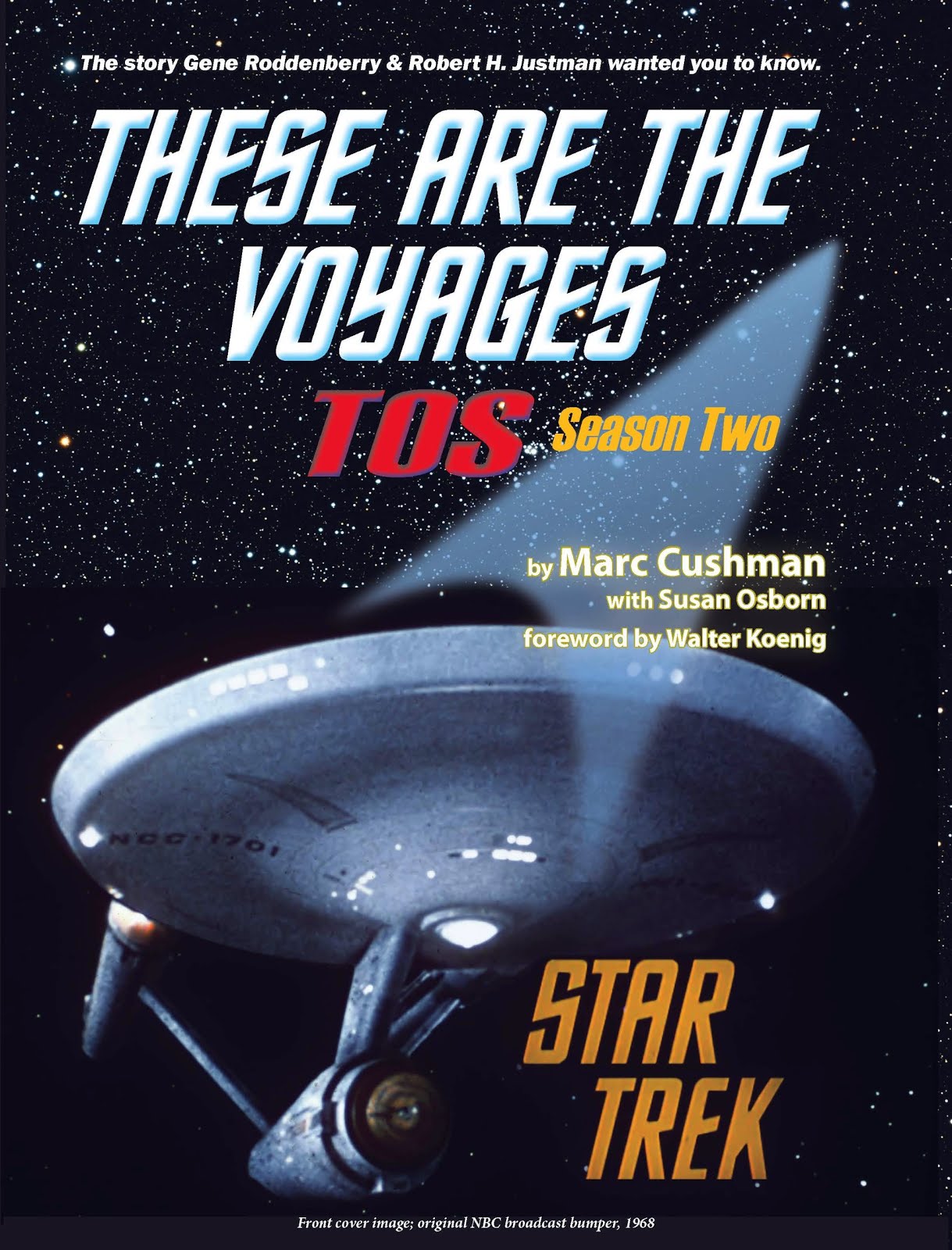
These Are The Voyages: TOS, Season Two

THESE ARE THE VOYAGES: TOS, SEASON TWO
by Marc Cushman with Susan Osborn
Foreword by Walter Koenig
688 pages
Published by Jacobs/Brown Press

Read August 27, 2014


These Are the Voyages TOS Season Two.jpg
Hardcover: Amazon.com | Amazon.ca | Amazon.co.uk
Paperback: Amazon.com | Amazon.ca | Amazon.co.uk
E-book (Kindle): Amazon.com | Amazon.ca


Publisher’s Description:
In the 1980s Gene Roddenberry and Robert H. Justman gave Marc Cushman permission to write the definitive history of the first Star Trek. They backed their stamp of approval by providing documentation never before shared with the public. These Are The Voyages, published in three volumes - one designated for each season of TOS (The Original Series) - will take you back in time and put you into the producers’ offices, the writers’ room, onto the soundstages, and in front of your TV sets for the first historic broadcasts. Included are hundreds of memos between Roddenberry and his staff, production schedules, budgets, fan letters, behind-the-scenes images, and the TV ratings. Buckle your seat belts; the trek of a lifetime continues with Season Two.

My Thoughts:

As with the first These Are the Voyages, Marc Cushman has provided fans with a gargantuan, meticulously-researched volume of facts, trivia, and first-hand accounts of the creation of Star Trek, this time chronicling the classic television show’s second season.

The opening chapters focus on the transition from season one to season two, including the suspense with regards to whether or not the expensive-to-produce show would be renewed. The story of Star Trek behind the scenes is just as exciting as the Star Trek we got on our television sets each week. The very real sense of franticness and difficulty in producing Star Trek is palapble as one reads the pages of this section.

Individual episodes are featured in production order as the discussion between the producers, writers, and the network is chronicled, with each episode getting a separate chapter. The cast of characters featured by Cushman are at times both larger-than-life and surprisingly human. Through their memos regarding each episode’s script and production, we hear the voices of each of the producers and writers: Gene Roddenberry often insisting on a larger “message” to include in each script, Gene Coon focused on creating and maintaining a consistent “Star Trek feel,” Dorothy Fontana and her brilliant eye for characters and drama, and Robert Justman’s protestations about budget and believability couched in a sometimes dark sense of humor.

Also included in each episode’s summary are reminiscences of guest actors and writers, the Neilsen ratings, and the historical context in which each episode was produced. Reportedly, Cushman’s editor did a lot of work to get him to trim back the amount of information included in this book. I can see how it would have been easy to get carried away. Even with the trims, there is a lot here, more than in the first book. And I’m informed that the third volume has even more with which to fill its pages!

Interstitial chapters feature various writers and other background personnel as they join the production, such as David Gerrold and John Meredyth Lucas. Other sections are included, such as depictions of Star Trek in the popular media of the time and, of particular interest, an overview of story ideas that were purchased and in some cases even developed, but never aired.

As with the first volume, the real joy in These Are the Voyages: TOS, Season Two comes in sitting down with the hefty tome and re-watching the episodes. Even someone such as myself, who has seen each episode an uncountable number of times, can pick new things out of the show while following along with Cushman as he revisits the world of 1960s television production.


Final Thoughts:

Above all else, this book is a lot of fun to read. Even the most ardent Star Trek fan will find something new and exciting about their favorite entertainment in the pages of These Are the Voyages. And, as mentioned above, season 3 has even more to talk about. I am very fascinated to learn more about that troubled season, and I am very much looking forward to the third and final volume of These Are the Voyages: TOS.

My next read:

Next up, as promised months ago, is my review of James Swallow's Terok Nor: Day of the Vipers, a tale of The Lost Era!


Monday, September 8, 2014

The Klingon Art of War

The Klingon Art of War: Ancient Principles of Ruthless Honor
Translated from the original Klingon by Keith R.A. DeCandido
Release date: May 6th 2014
Read July 8th 2014


Hardcover: Amazon.com | Amazon.ca | Amazon.co.uk
E-book (Kindle): Amazon.com | Amazon.ca | Amazon.co.uk


From the back cover:
Passed down from the time of Kahless, ten precepts have shaped Klingon culture and indoctrinated Klingons in the Way of the Warrior. With this new translation, people from all walks of life-and all worlds-can harness the ancient Klingon wisdom and learn to embody courage, discipline, and honor. 
CHOOSE YOUR ENEMIES WELL
STRIKE QUICKLY OR STRIKE NOT
ALWAYS FACE YOUR ENEMY
SEEK ADVERSITY
REVEAL YOUR TRUE SELF IN COMBAT
DESTROY WEAKNESS
LEAVE NOTHING UNTIL TOMORROW
CHOOSE DEATH OVER CHAINS
DIE STANDING UP
GUARD HONOR ABOVE ALL

My thoughts:

The Klingon Art of War
 (or qeS'a' in Klingon) marks an occasion I have been waiting for for some time: the return of Keith R.A. DeCandido to Trek lit... sort of. I mean, this book isn't exactly a Star Trek novel, but it is a work of fiction. An in-universe reference book, if you will. But boy is it tempting to call it non-fiction!

Using examples from throughout the history of the Klingon civilization, the book's "author," renowned novelist K'Ratak, dispenses sage wisdom for Klingons and non-Klingons alike, and for both warriors and non-warriors. The precepts and their implications are meant to be used by people from all walks of life, from the warrior on the deck of a Vor'cha-class attack cruiser to a well-known author dealing with his critics!

I very much enjoyed the "voice" of K'Ratak as he relays the original stories behind the precepts, as well as his own "author commentary" on each precept and the morals it conveys. I especially enjoyed the stories he told of his own life and times in which the lessons of the qeS'a' informed his behaviour. This was the perfect project for Klingon expert DeCandido. I have not yet read his I.K.S. Gorkon/Klingon Empire novels, but after reading this book, I realize that they have to be made a priority in the near future.

The references in the book to the wider Star Trek literature world are very welcome, including mention of the Typhon Pact, indicating that the book is written contemporaneous to the current post-Nemesis 24th century novel continuity. I love it when the lit-verse and canon Trek come together in these supplemental works. As much as I enjoyed Federation: The First 150 Years from a couple of years ago, I was disappointed when it didn't completely mesh with the modern novels. The Klingon Art of War does much better in this area.

Finally, the art work at the beginning of each chapter is very well done, and perfectly fitting for this book. The style and layout is fun to read, and I recommend The Klingon Art of War for any fan of Trek and the Klingons!

Further resources:

Also by Keith R.A. DeCandido:

My next read:

Next up is my review of Seekers #2: Point of Divergence by Dayton Ward & Kevin Dilmore!


Wednesday, August 28, 2013

These Are the Voyages - TOS, Season One

These Are The Voyages:
TOS, Season One 
by Marc Cushman with Susan Osborn
Release date: August 1st, 2013
Published by Jacobs Brown Press


Purchase from Amazon.com

From the back cover:
Author, Marc Cushman, had the great honor of befriending both Gene Roddenberry and Robert H. Justman. As a result of that friendship, Marc was given access to all the Star Trek® production documents from the three years the series ran, which are currently housed in the UCLA Archives under a bequest by Roddenberry and Justman. These documents are private and viewing is restricted and supervised. This work is derived from eight months spent researching the details of the production. These books reveal, for the first time, the truth behind all the politics and behind-the-scene machinations of the productions. Rod Roddenberry, said: "This is going to be the bible to STAR TREK® and how it was made. This is a book that I'm going to keep near and dear and utilize throughout my life." These are the Voyages, TOS, Season One contains hundreds of previously unpublished insights and recollections from actors, directors, producers, and production crew, capturing what went on from every perspective, including memos dictated by Roddenberry while reading drafts to the series scripts. The book offers a unique look behind-the-scenes in the form of original staff memos, contracts, schedules, budgets, network correspondence, and the censor reports from NBC. These are the Voyages creates the opportunity for readers to transport themselves back in space and time to witness the true history of Season One of Star Trek®: TOS. Go behind the closed doors of NBC, Desilu/Paramount, the producers' offices, the writers' room, the sound stages and shooting locations, and learn the actual facts behind all the blood, sweat, tears, politics, and spellbinding creativity that brought Star Trek® into being...and changed the Sci Fi world. This book looks behind the scenes in the form of original staff memos -- including Gene Roddenberry's own memos, contracts, schedules, budgets, network correspondence, censor reports and other newly-uncovered documentation.

My thoughts:

Ordinarily, this site concerns itself mainly with books from Pocket Books' Star Trek fiction line. However, I recently had the opportunity to review a unique book: These Are The Voyages: TOS, Season One, the first entry in a three-volume series of in-depth, comprehensive books detailing the production of Star Trek: The Original Series.

As a fairly knowledgeable Star Trek fan, I have read a great deal about the history and production of Star Trek. Like many other fans, over the years I've gleaned a lot of information and "inside stories" about the events that brought my favorite science-fiction franchise into being. Having said that, the sheer amount of information in These Are The Voyages: TOS, Season One absolutely blew me away. The book itself, already not small, is packed from cover to cover with every bit of information you could possibly want about the production of The Original Series.

Gene Roddenberry and the Enterprise

The first chapter talks all about the creator of Star Trek, Gene Roddenberry. Most Trek fans know a lot of the broad strokes about his life, but These Are The Voyages goes even deeper. In what would become a familiar theme during my reading of this book, I was endlessly fascinated and amazed by the amount of detailed information about Roddenberry's life. Page after page revealed a new tidbit of information that I had not previously known. From there, the book goes on to talk about the conception and realization of what would come to be known as Star Trek.

However, the author takes a broader view than merely chronicling the birth of the series. Rather, he goes into great depth describing the situation on television at the time, providing useful information such as the histories of the major television networks and studios, setting the stage for the emergence of Star Trek. The breadth of the information provided makes for a fascinating read and provides insights about Star Trek's beginnings that would otherwise remain unknown to a younger fan such as me, who was not yet alive during this period.

Production of the fan-favorite and critically-acclaimed "City on the Edge of Forever."

The majority of the book features the episodes that make up Star Trek's first season. It is in these chapters that the book really shines! The in-depth coverage for each episode begins with the original NBC press release followed by a brief critique of the episode. The real treasure comes with the recounting of the inception of the idea for the episode, followed by the back-and-forth process of writing, pre-production, and production. The insights into the industry as a whole and the early days of Star Trek in particular are very eye-opening.

For most people, the information in these chapters will lead to a whole new appreciation of each episode. The analysis of each episode is appropriately critical and in-depth. The tendency in a lot of publications is to fawn over the wonder that was Star Trek and to gloss over the rough patches. Not so here. These Are The Voyages is an uncompromising look at the steps (and sometimes missteps) that went into creating The Original Series. A great example is the chapter on the creation of the episode "Court Martial." At each step, the production ran into difficulties, and while the finished episode isn't terrible, there are a number of flaws that survived from writing through to post-production. Although I had to read quickly in order to do this review, I have plans to go back and slowly read through each episode chapter while simultaneously doing a TOS season one re-watch. I have a feeling that the experience would be pretty rewarding!

The cast pretends to shave with their phasers between takes during the filming of "Operation: Annihilate!"


Final thoughts:

Meticulously researched and lovingly presented, the amount of work put into this book is apparent on nearly every page. To a serious fan of Star Trek, These Are The Voyages: TOS, Season One will serve not only as an interesting reference, but as a time capsule of sorts. This is the sort of supplementary material that will not simply sit on one's shelf for years; rather, many people will find themselves consulting it often to learn more about their favorite (or not-so-favorite) episodes. This appears to be the definitive account of the first season of Star Trek, and I for one cannot wait to get my hands on volumes two and three.

My next read:

Unfortunately, I've gotten behind, and my reviews of the stories in the second S.C.E. omnibus will have to wait for a little while. I've recently been reading the first book in The Fall series, David R. George III's Revelation and Dust. Review coming soon!